Paper I: The Stellar Kinematics and Metallicites of
19 Extremely-Low-Mass Milky Way Satellites
(Cerny et al. 2026, arxiv: 2602.17652)
Deep, wide-area photometric surveys have uncovered a population of compact, extremely-low-mass stellar systems in the Milky Way halo that are smaller in size than known ultra-faint dwarf galaxies (UFDs) and substantially fainter than most classical globular clusters (GCs). Very little is known about the nature and origins of this population of “Ultra-Faint Compact Satellites” (UFCSs) owing to a dearth of spectroscopic measurements. In Paper I, we present the first spectroscopic census of these compact systems based on Magellan/IMACS and Keck/DEIMOS observations of 19 individual UFCSs, representing ∼2/3 of the known population.
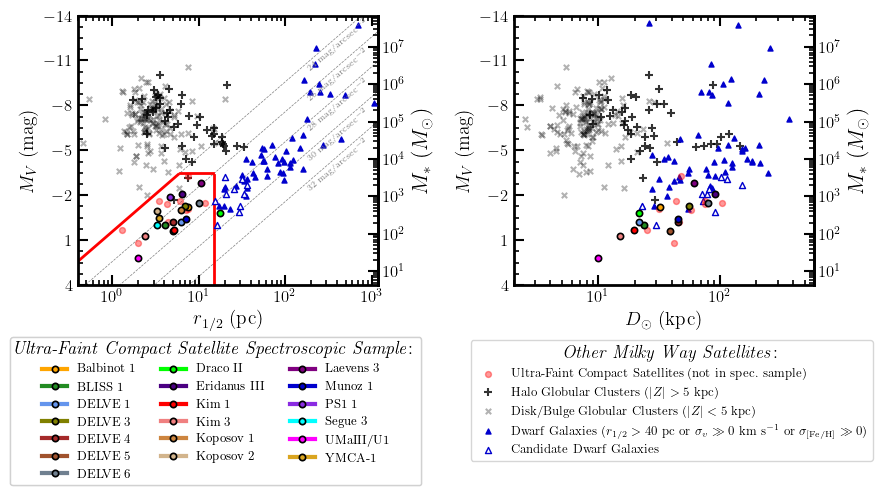
Defining the Ultra-Faint Compact Satellites
We begin by defining the population of Ultra-Faint Compact Satellites (UFCSs) based on four selections:
(1) Azimuthally-averaged half-light radii $r_{1/2} < 15$ pc
(2) Absolute magnitudes $M_V > -3.5$ ($M_* \lesssim 4000 \, \rm M_{\odot}$)
(3) Surface Brightness $\mu_V > -24$ mag/arcsec$^2$
(4) Galactocentric positions outside of the disk plane ($|Z| > 5$ kpc)
This yielded a total known population of 30 UFCSs discovered in recent surveys, in addition to two classical globular clusters. The resulting sample of UFCSs spans a heliocentric distance range $10 \rm \ kpc < D_{\odot} < 105 \ kpc$, though the lack of UFCSs at larger distances is almost certainly a selection effect.
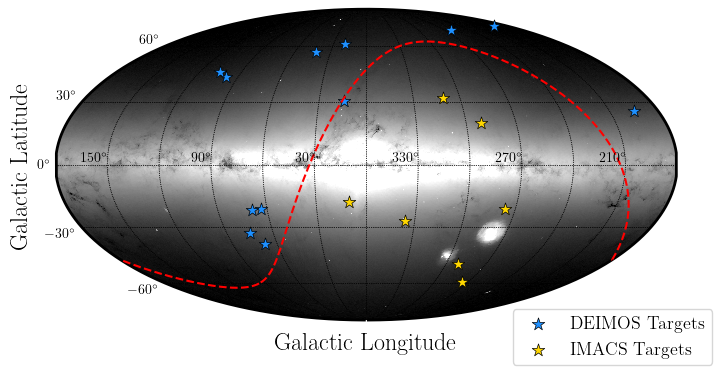
A Dual-Hemisphere Spectroscopic Campaign:
212 Stellar Members across 19 UFCSs
We targeted 19 UFCSs across both the northern sky and southern sky using Keck/DEIMOS and Magellan/IMACS (respectively), representing $\sim$2/3 the known UFCS population. Prior to the initiation of our census, only four UFCSs had published spectroscopic studies. Our census more than triples the sample of UFCSs with radial velocities and metallicities!
Combining our new spectroscopy with ground-based photometry and astrometry from Gaia, we confirm between 3 and 35 spectroscopic member stars per UFCS (with a median of 9 per system). We use these member samples to measure the radial velocities and proper motions of the 19 UFCSs, setting the stage for analyses of their orbits.
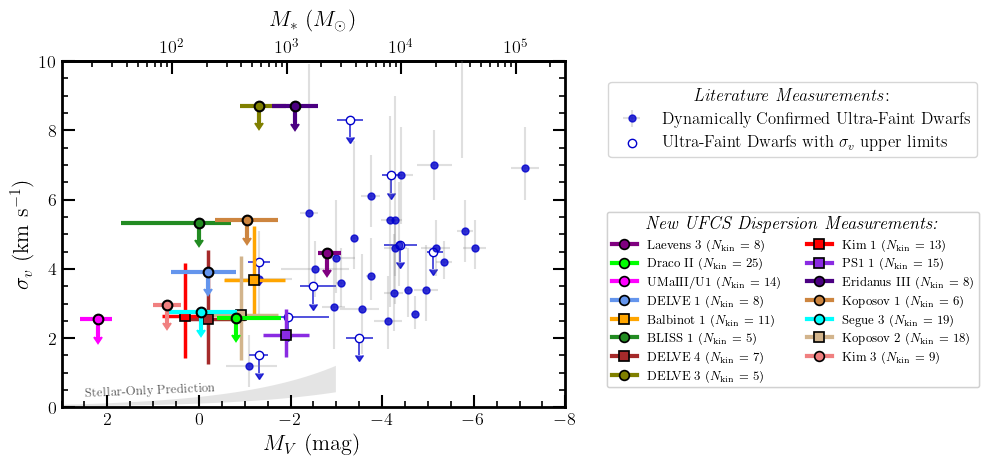
Key Result: the UFCSs are Kinematically Cold
We measure the velocity dispersions of 15 of our 19 UFCSs from samples of $\geq 5$ stars. In 10 of these 15 cases, we recover only upper limits, demonstrating that the UFCSs are kinematically cold systems. The remaining 5 cases displayed resolved or marginally-resolved dispersions at the $\sigma_v \approx 2\mbox{--}4$ km/s level, though jackknife tests suggest these cases are sensitive to individual member stars and may not be robust.
The preponderance of upper limits and small dispersions disfavors very dense dark matter halos for the UFCSs -- a prediction of some dark matter models (if they are galaxies) -- and exemplifies the challenge in classifying these systems based on their stellar kinematics.
Key Result: the UFCS Population is Chemically Diverse and Extends Below $\rm [Fe/H] = -2.5$
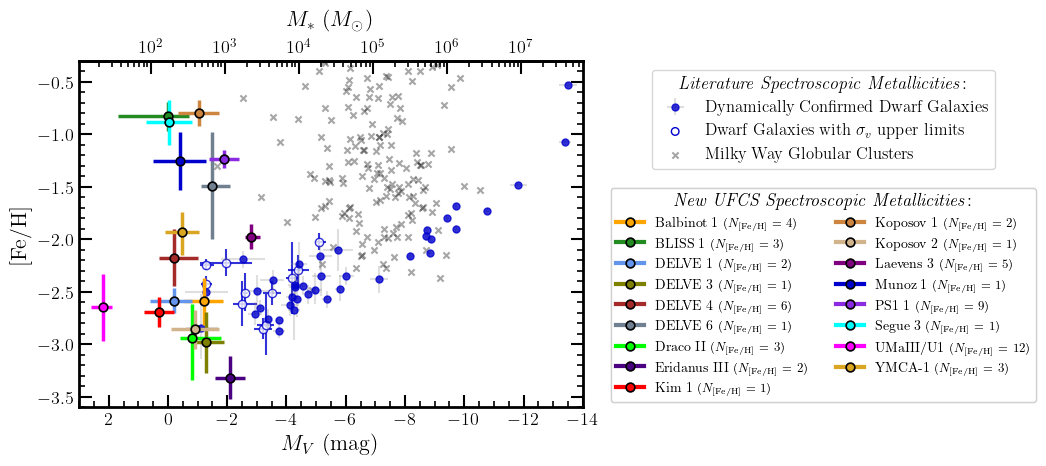
We measure the iron abundance ([Fe/H]) of at least one star in 17 UFCSs, finding:
(1) The UFCSs are chemically diverse, spaning a factor of $\sim$300 in mean metallicity
($\rm -3.3 \lesssim [Fe/H] \lesssim -0.8$).
(2) We report the new discovery of a population of compact MW satellites below the claimed globular cluster metallicity floor of $\rm [Fe/H] \approx -2.5$. These UFCSs potentially resemble the progenitors of the most metal-poor stellar streams seen around the MW.
(3) We find only a single UFCS with metallicity $\rm [Fe/H] < -3$. If the UFSCs are indeed galaxies, this dearth of extremely-metal-poor UFCSs supports the existence of a plateau in the dwarf galaxy luminosity-metallicity relation at the faint end.
Dwarf Galaxies or Star Clusters?
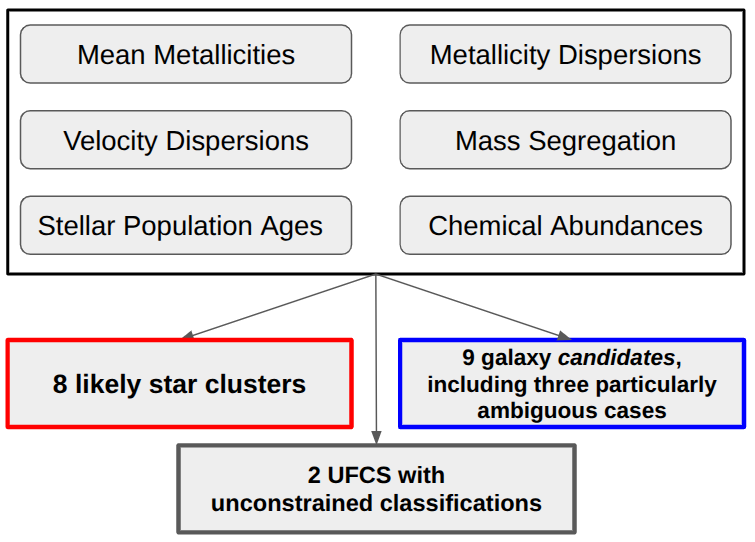
Using our new kinematic and chemical measurements, paired with literature age and mass segregation measurements, we attempt to classify all 19 UFCSs in our sample. We find:
(1) 8 of 19 UFCSs in our sample are very likely star clusters based on their higher metallicities and/or younger ages. Further considering the two classical GCs meeting our UFCS definition, the fraction of the MW UFCSs that are likely star clusters is >40-50%.
(2) 6 of 19 UFCSs in our sample are promising ultra-low-mass galaxy candidates, as suggested by their very low mean metallicities ([Fe/H] < -2.5). 3 additional UFCSs have particularly ambiguous classifications but are plausibly galaxy candidates as well. Taken together, our results suggest that up to 50% of the UFCSs could be galaxies.
(3) The classifications of the remaining 2 of 19 UFCSs in our sample remain unconstrained. Further follow-up targeting these 2 systems, as well as the 11 additional UFCSs not in our spectroscopic sample, will be necessary to classify them as dwarf galaxies or star clusters.
(4) We find no evidence for correlations between the sizes and masses of the UFCSs and our assigned classifications, implying that spectroscopic follow-up will continue to be essential for classifying all future UFCS discoveries.
Key Result: A Growing Excess of Low-Mass Milky Way Halo Clusters
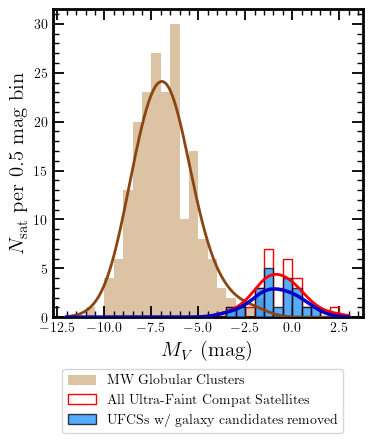
We highlight an apparent excess of low-mass MW halo star clusters, centered at $M_V \approx -1$ ($M_* \approx 400 \rm \ M_{\odot}$), that is clearly inconsistent with the lognormal tail of the MW GC luminosity function. While this feature has been noted before, we demonstrate for the first time that this feature perists after removing the sample of UFCSs that are galaxy candidates. In other words, star cluster--galaxy confusion can no longer explain this excess of low-luminosity GCs relative to the expected GCLF lognormal tail.
While the origin of this excess of low-mass clusters remains unknown, we speculate that this feature of the GCLF reflects the contribution of recently-accreted low-mass star clusters from the LMC, SMC, and Sagittarius. By virtue of their recent infall times, these UFCSs would have experienced gentler tidal fields throughout their lifetimes.